Table of contents
Across major cities, community gardening is quietly reshaping how people talk about anxiety, loneliness, and burnout, not through slogans but through shared work, visible progress, and low-stakes conversation. Public health agencies increasingly frame social connection as a determinant of wellbeing, and gardens offer something rare in urban life: routine contact with neighbors and a reason to show up. The result is not just better access to fresh produce, but a shift in language, norms, and confidence around seeking help, especially in communities where mental health still carries stigma.
In the beds, people start talking
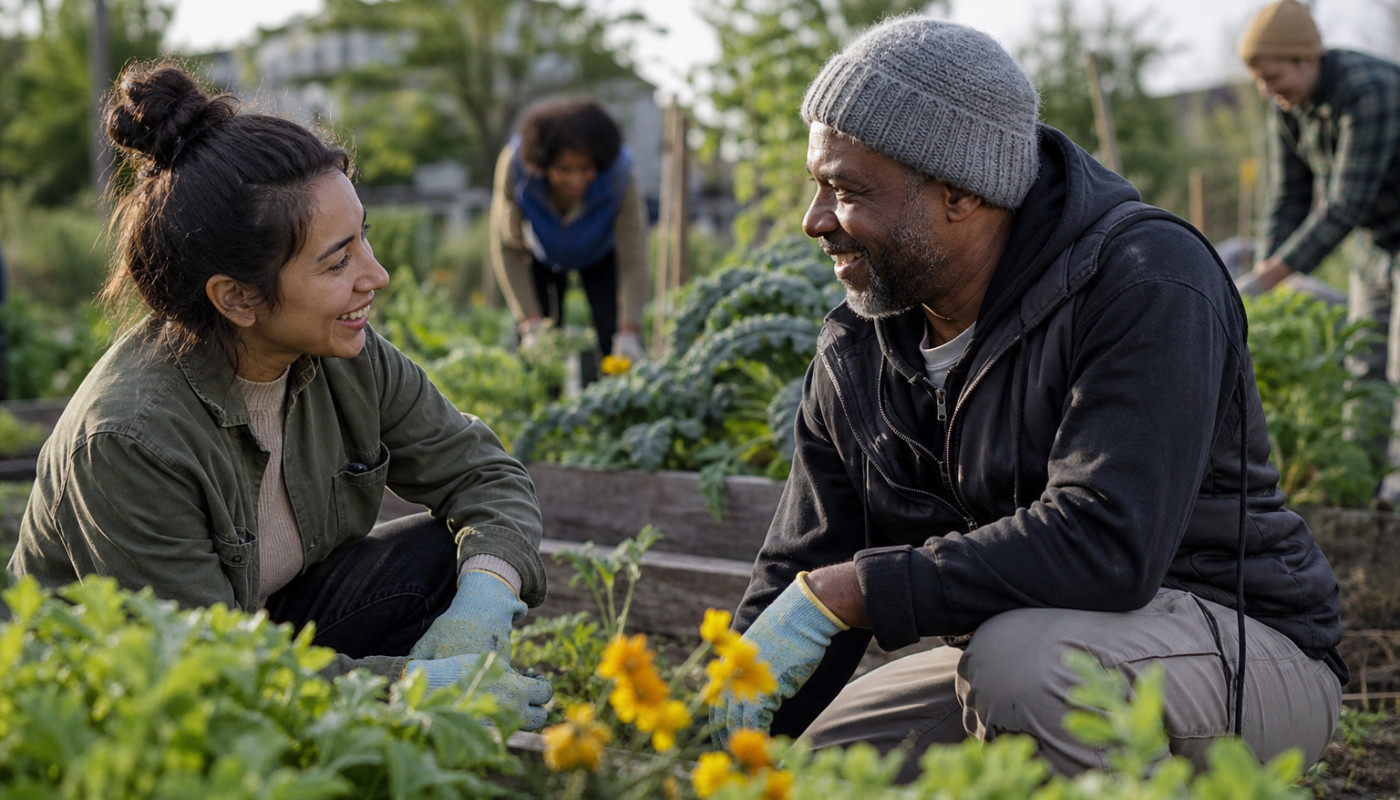
It rarely begins as a “mental health conversation”, and that is precisely the point. In many community gardens, the first exchanges are practical, even mundane, about compost ratios, watering schedules, aphids on kale, and which seedlings survived the weekend heat. Yet as the work repeats and familiar faces return, the talk changes shape, moving from tasks to lives, and from lives to strain: a parent’s exhaustion, a job loss, a spell of insomnia, an older neighbor’s grief. The garden supplies a socially acceptable bridge, because it offers proximity without pressure, and it lets silence exist without feeling like failure.
Researchers have long linked social support to lower psychological distress, but “support” can sound abstract until you see how it forms in public. Studies of green and blue spaces repeatedly associate nature exposure with reduced stress and improved mood, while the social layer adds another pathway: belonging. A widely cited meta-analysis in Environmental Research (2019) found consistent associations between green space exposure and better mental health outcomes, including lower odds of depression, even if causality remains hard to pin down. Community gardens fold that evidence into a civic setting, where repeated encounters build trust, and trust makes it easier to name what hurts, ask for advice, or accept a referral, without the conversation feeling clinical.
What makes gardening distinct from many wellbeing initiatives is that it is not marketed as therapy, and therefore tends to draw people who would never sign up for a “support group”. That matters in neighborhoods where mental health services are scarce or culturally fraught, and where the fear of being labeled can deter early help-seeking. The garden’s shared purpose, and the small talk that comes with it, can normalize vulnerability, because it arrives in fragments, attached to something else: “I haven’t been sleeping”, “My chest feels tight lately”, “I’m struggling to keep up”. Those statements are not yet diagnoses, but they are openings, and openings are how dialogue starts.
Why gardens feel safer than clinics
One of the sharpest divides in mental health is not between those who need support and those who do not, but between those who feel permitted to ask and those who do not. Clinics and hotlines matter, yet for many people they remain intimidating, expensive, or logistically unreachable. Community gardens, by contrast, are familiar, visible, and often free, and because they are not framed as medical spaces they reduce the sense of scrutiny. The conversation can happen sideways, while tying up tomato vines or turning soil, and that angle matters for people who fear judgment.
There is also a body-based component that psychology recognizes even when public debate forgets it. Moderate physical activity is associated with improved mood and reduced symptoms of anxiety and depression, and the U.S. Centers for Disease Control and Prevention repeatedly highlights physical activity as a protective factor for mental health. Gardening typically sits in a sweet spot: active enough to raise the heart rate, gentle enough for older adults, and adaptable for different abilities. Add sunlight and outdoor time, and you get a package that many urban residents struggle to assemble on their own, especially those working multiple jobs or living in cramped housing.
Safety, in this context, is social as much as physical. A garden’s culture can create what community psychologists call “informal social control”: neighbors notice when someone disappears, and they check in, not as professionals but as peers. That simple act can interrupt isolation, a known risk factor for depression and suicidality. The U.S. Surgeon General’s 2023 advisory on loneliness and isolation framed social disconnection as a public health concern, citing links to increased risk of premature mortality and poorer mental and physical outcomes. Community gardens will not replace healthcare, but they can reduce the distance between a person and the moment they accept help.
Some garden organizers now collaborate with local nonprofits, libraries, and health departments to host low-key workshops, often framed around stress management, nutrition, or seasonal routines rather than diagnoses. The tactic is subtle: it respects the garden as a place of autonomy, and it meets people where they are. Tools that help coordinators plan communications, coordinate volunteers, and share resources can amplify that effect, and readers who want to explore how digital support systems are being designed around everyday communities can visit site for a view into the broader ecosystem of AI assistants and related tools.
The data behind “green social care”
The phrase “social prescribing” has moved from niche policy circles into mainstream debate, particularly in the United Kingdom, where the National Health Service has supported referrals to non-clinical activities, including gardening, walking groups, and arts programs. NHS England has described social prescribing as a way to address non-medical drivers of health, from housing stress to loneliness, and while outcome measurement varies by program, the direction is clear: policymakers are treating community activities as part of the mental health landscape, not as a footnote to it.
Evidence for gardening’s mental health benefits is growing, though it is not uniform, and that nuance matters. A meta-analysis in Preventive Medicine Reports (2017) reported that gardening interventions were associated with reductions in depression and anxiety symptoms, as well as increases in life satisfaction and quality of life, but it also noted variability in study design and the need for more robust trials. Another line of research looks at horticultural therapy, which is more structured and often delivered in clinical or rehabilitative settings; those studies frequently show improvements in mood and perceived stress, especially among older adults and people with chronic conditions.
Community gardening sits somewhere between the informal and the therapeutic, and that in-between quality is part of its power, but also part of the measurement challenge. Randomized controlled trials are hard to run when participation is voluntary, and when benefits may come from several intertwined mechanisms: exercise, sunlight, improved diet, a sense of achievement, and social contact. Yet observational studies and quasi-experimental work continue to suggest meaningful effects. In dense cities, where access to private outdoor space is unequal, the garden may act as a small correction to environmental disparities that track income and race, and those disparities are themselves linked to mental health outcomes.
There is also an economic argument quietly underpinning the policy interest. Mental ill-health carries large productivity costs and strains public services, and community-based prevention is cheaper than crisis response, even if it cannot replace clinical care. When a garden reduces isolation for older adults, keeps someone engaged after bereavement, or offers a routine to a young person drifting away from school, the benefit may not show up immediately in a medical chart, but it can still be real. The most rigorous claims should remain cautious, yet the broad pattern, across countries and study types, is increasingly hard to dismiss.
When a shared harvest reduces stigma
Stigma thrives in silence, and silence thrives where people do not know each other. Community gardening can loosen both, not by forcing disclosures but by making ordinary contact frequent. The harvest becomes a social currency: a bag of beans left on a bench, herbs offered to a neighbor, surplus shared with a food pantry. These exchanges create a story of mutual aid, and mutual aid reshapes how communities interpret vulnerability. If you accept help with watering because you were overwhelmed this week, it becomes easier to imagine accepting help for something heavier.
The garden also changes who gets to be seen as competent. Someone struggling at work might be the person who knows how to revive tired soil, and competence is protective, because it restores agency. Mental health discourse often collapses people into their symptoms, but gardening highlights roles: mentor, builder, organizer, seed-saver, mediator. That identity shift can soften self-stigma, the internalized belief that needing support makes you lesser. When people experience themselves as useful to others, they are more likely to speak honestly about their limits, and more likely to seek support before a situation becomes acute.
Yet gardens are not automatically inclusive. Conflicts over plots, cultural disagreements about what to grow, and unequal access to time and tools can reproduce the same stresses people carry elsewhere. The projects that most effectively support mental health tend to be intentional about governance, transparent about decision-making, and attentive to basic needs, including shade, seating, and accessible paths. Some also build partnerships with local mental health organizations, not to medicalize the space, but to ensure that when serious issues surface, there is a clear path to professional care.
Done well, community gardens can become civic micro-institutions, places where people practice cooperation and learn to talk about hard things without turning every hardship into a private failure. In that sense, their contribution to mental health is not only personal, it is cultural, because they expand the settings in which it is normal to say, calmly and without spectacle, “I’m not doing great”, and to hear, in response, “Let’s figure it out”.
How to join, budget, and find support
Start with your city or borough’s parks department, a local land trust, or a neighborhood association, and ask about plot waiting lists, volunteer days, and orientation sessions. Expect modest annual fees in many gardens, often used for water, tools, and insurance, while some programs offer free participation in exchange for volunteer hours. Look for local grants and “green” community funds, and check whether nonprofits can subsidize fees, tools, or raised beds for accessibility.
On the same subject


